
The Association of Mutual Funds in India (Amfi) has already taken up the matter with the market regulator and the finance ministry.

Companies in the lower mcap deciles have recorded the fastest growth in median mcap.

ffIn an hour-long chat on on rediff.com on Friday, MCX-Zee Business award winning Mutual Fund expert, Ashok Kumar offered some tips on mutual funds.

Innovation is the name of the game for mutual fund marketeers. But your financial need is what should matter.

The move comes within months of a crisis at JPMorgan Asset Management Company.

Adani Ports and Special Economic Zone has repaid Rs 1,500 crore loan and will repay another Rs 1,000 crore in commercial papers due in March. The Adani Group firm paid Rs 1,000 crore to SBI Mutual Fund and Rs 500 crore to Aditya Birla Sun Life Mutual Fund on commercial papers that matured on Monday, as scheduled.

Driven by inflows into Systematic Investment Plans (SIPs), the mutual fund industry's total assets under management rose to Rs 39.88 lakh crore in September from Rs 36.73 lakh crore in the year-ago period. On a monthly basis, the Assets Under Management (AUM) increased marginally from Rs 39.33 lakh crore in August. According to the latest monthly data from the Association of Mutual Funds in India (Amfi) released on Monday, the industry wide net AUM stood at Rs 38.42 lakh crore in September.
Before deciding to go for mutual fund ELSS, here are some points to ponder over.

'I don't see fear becoming a dominant factor for retail investors.'

The market regulator said the mutual fund industry was doing fine and industry representatives agreed.

The newest entrant to the Rs 46-trillion mutual fund (MF) space - Zerodha - plans to focus strictly on the low-cost passive segment and offer its products solely through the commission-free digital route, as it aims to replicate its broking success in the MF space. "We will offer an array of exchange-traded funds (ETFs) and index funds that would help investors take varied exposures and build portfolios based on their financial needs and risk tolerance. "Zerodha Fund House (FH) products will be exclusively distributed online and available as direct plans to engage directly with individual investors and consumers, taking advantage of the pronounced shift from physical to digital interactions," said Vishal Jain, chief executive officer, Zerodha FH.

The Indian government has introduced a 0.4% Merchant Discount Rate (MDR) on UPI person-to-merchant (P2M) transactions exceeding Rs 2,000, effective October 15. This move ends nearly six years of fully free UPI payments, though person-to-person (P2P) transfers and small P2M payments remain free. The charges aim to bolster investment in UPI infrastructure, with specific exemptions and caps for essential sectors.

Equity flows turning positive could give fund managers firepower to invest in the markets. This could come in handy as flows from foreign investors have tapered off amid rising bond yields in the US.

For the first time in a decade, inflows into equity mutual funds (MFs) decoupled from the past performance of the equity market, as investors continued to pour money into the market unperturbed by lacklustre returns.
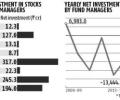
After relentlessly selling shares for most of 2013, India's equity mutual fund managers have turned buyers in the fag-end of the year.

Why should I invest in mutual funds? Why cannot I invest in equities directly? Here are 7 simple reasons

An employee whose financial future is 60-80 per cent dependent on a single company's growth trajectory has no genuine safety net.
Even as the returns of mutual fund (MF) schemes have improved considerably in the past three months, addition of new investors has remained in the slow lane for the MF industry. According to industry data, during the first six months of CY 2023, MFs onboarded only 1.6 million new unique investors, in stark contrast to the 4.7 million investors added during the same period last CY and the 2.4 million in 2021. It is noteworthy, however, that the current additions for this year have doubled in comparison to the figure of 800,000 seen in 2020.

Experts say you may invest in small-sized funds and benefit from their nimbleness.
The change in debt fund taxation is seen as boosting the demand for hybrid funds. It is no surprise then that asset management companies (AMCs) have launched a raft of new products in the multi-asset category. However, they seem to be divided on the asset mix and approach. The multi-asset space, which provides fund houses ample scope to innovate, has seen five launches in as many months.

Notwithstanding sharp volatility in March, mutual fund (MF) investors didn't fight shy of investing in riskier small-cap-oriented schemes. Inflows into small-cap funds were not just the highest in absolute terms, they were also the maximum as a proportion of assets under management (AUM) among all market capitalisation (m-cap)-oriented categories. Investors funnelled Rs 2,430 crore down small-cap funds - 1.8 per cent of their AUM of Rs 1.33 trillion.

With this, the total SIP contribution in the first seven months of the current financial year rose to Rs 57,607 crore as compared with Rs 52,472 crore in April-October 2018, according to the latest data from the Association of Mutual Funds in India (Amfi).

Debt fund managers are reassessing their strategies after the setback delivered by the Reserve Bank of India recently. While most are refraining from any knee-jerk reaction to the central bank's surprise open market operation (OMO) announcements, they are taking a re-look at the duration of their schemes. Sandeep Yadav, head of fixed income at DSP Mutual Fund, said it has trimmed the duration of some schemes, considering the hawkish stance by the RBI.

Futures and options (F&O) trading suits investors with good market knowledge, sufficient risk capital, a tested strategy and strong discipline.

Investors should use a mix of active and passive funds.

The steady inflows from systematic investment plans (SIPs) into mutual funds (MFs), coupled with outflows from debt schemes, has propelled the share of SIPs in the total assets being managed by the industry to a new high of 17.1 per cent in February. SIPs are used predominantly by retail investors. Nearly seven of every 10 SIP accounts are in equity-oriented active MF schemes.

Mutual funds have invested nearly Rs 94,500 crore in equities thus far in CY17, compared to Rs 32,000 crore in the year ago period, at a time when foreign investors have turned net sellers of India since August.
After life insurance, DLF Ltd is foraying into asset management by offering local and global mutual funds through a joint venture with Prudential Financial Inc of the United States.
The mutual fund industry saw an average growth of 63 per cent in assets under management in 2006

By diversifying into developed market equities, Indian investors can mitigate the impact of cyclicality in returns as well as reduce currency risk, experts tell Sanjay Kumar Singh.

The case for long-term investment in gold, however, remains intact.

A Balasubramanian tells Business Standard that the sector will see one of its best phases in the coming five years.

Several mutual funds (MFs) have recently approached the Reserve Bank of India (RBI) as they renew efforts to increase their overseas investment limit. In June 2022, the capital markets regulator Securities and Exchange Board of India (Sebi) permitted MFs to invest in foreign stocks within the aggregate mandated limit of $7 billion after a correction in stocks. One of the proposals shared with the RBI is to link MFs' foreign investment limit to the country's foreign exchange reserves.
